Sunday, December 25, 2011

Morris Finalists 2012: Where Things Come Back


I've decided to read the finalists for the 2012 William A. Morris YA Debut Award! If you're new to the Morris, it "honors a debut book published by a first-time author writing for teens" and celebrates "impressive new voices in young adult literature." I've requested the five finalists from the library and am hoping they all come in while I'm on winter break.

My first read is Where Things Come Back by John Corey Whaley. This book was a bit of a mystery to me after reading the inside of the jacket. The jacket copy talks about lighthearted tales of adolescent love, the disappearance of a little brother, an extinct woodpecker, zombies and talking birds, without weaving any of those items into any kind of plot summary.

So I have to tell you that there are no real zombies. Real inside of the book, I mean. They're imaginary, both outside and inside the story. If you're looking for a good zombie story, this isn't it.

But it's definitely worth reading anyway. Here's what really happens: Cullen Witter's younger (and not so little) brother disappears around the same time that a college professor arrives in his small Arkansas town to search for signs of a rare woodpecker that is believed to be extinct. The whole town goes gaga over the possibility of the woodpecker being found there, and while they do care about the Witters and search for Gabriel (the brother), Cullen often feels like the stupid and probably non-existent woodpecker is getting too much attention.

Meanwhile, in alternate chapters, we hear about failed teenage missionary Benton Sage, and his college roommate Cabot Searcy. This is confusing, because there is NO explanation in the beginning for how this fits in with the Cullen Witter story. Rest assured, it does tie in eventually.

The story as a whole seems a bit haphazard at first, but things are revealed at a good pace, which frequently had me thinking "What the HECK?!" (in a good way). And at a couple of points, "OMG, I'm going to be sick." Again, in a good way.

The Cullen Witter portions of the book are told in first person, while the other portions are in third person. I enjoyed Cullen both as a character and as a voice; he seemed like an authentic teenager. Whaley has him simultaneously dealing with his brother's disappearance and dating and worrying about girls and sex, which sounds ridiculous, but it works.

Overall, this is a well-written and engaging novel. It's complex enough to be interesting, but easy enough to read in a day or so. I look forward to seeing more from John Corey Whaley.


Saturday, November 12, 2011

Reading Broadly

I keep a list on Goodreads of "award possibilities" each year. It's mostly Newbery; this year it's pretty much all Newbery. (I did not love them all. They're just part of the discussion.) Here are the titles on my list with authors and/or protagonists who I know to be people of color, plus a few that are still on my shelf, waiting to be read.

Hidden, Helen Frost
Drawing From Memory, Allen Say
Can I See Your ID? True Stories of False Identities, Chris Barton (some stories)
Jefferson's Sons, Kimberly Brubaker Bradley
The Grand Plan to Fix Everything, Uma Krishnaswami
Lunch-Box Dream, Tony Abbott
Akata Witch, Nnedi Okorafor
Trapped, Marc Aronson
The Great Wall of Lucy Wu, Wendy Shang
Words in the Dust, Trent Reedy
Inside Out and Back Again, Thanhha Lai
The Queen of Water, Laura Resau / Maria Virginia Farinango
Heart and Soul, Kadir Nelson
Bird in a Box, Andrea Davis Pinkney
Never Forgotten, Patricia McKissack
Close to Famous, Joan Bauer


and a shoutout for Between Shades of Gray by Ruta Sepetys, about a cultural minority.

What have I left off?

Tuesday, October 25, 2011

Newbery Watch

I had an extraordinary reading experience at Elliott Bay Books today. I went there to read some of the easy readers that are being talked up on Heavy Medal. This is going to make me sound like a mooch--I REALLY DO spend money at bookstores usually--but I also went to finish Wonderstruck, which I'd gotten halfway through when I was waiting there for Laurie once. I'm on hold for it at the library, but I'm never, ever going to get it. I was loving Wonderstruck when I stopped. I almost bought it, but it is not an inexpensive book, and I seldom buy books I haven't read, so I am waiting. If I buy it, I promise to buy it from Elliott Bay. If I don't buy it, I promise to buy whatever I do buy from Elliott Bay, EVEN THOUGH I get triple points on my online bookstore-linked credit card if I buy books THERE. I have approximately 72 nieces and one nephew, so I buy a lotta books.

I read three Elephant and Piggie books. I was not impressed with them as Newbery Hopefuls. In a way, the discussion about them (and especially the reading experience) reminded me of how sometimes people tell me things like "you're such a good nurse, you should be a doctor!" I don't want to be a doctor. I'm happy being a nurse, which was pretty much always my dream. I try to be the best nurse I can be. The Elephant and Piggie books are great at what they are: marriages of text and illustration. Why try to shoehorn them into an award that's primarily for writing? I think it almost devalues the foundation of what makes these books good. Let them win the Geisel and let it go.

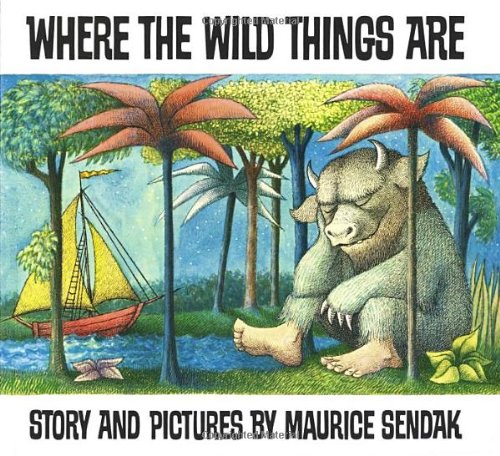
Secretly (oops) I don't think the Elephant and Piggie books are THAT great. I didn't think any of the three from this year were as good as We Are In a Book (also read for the first time tonight) or I Will Surprise My Friend (which I read with surprise and delight during my first year of ALA-awards-fandom), but none of them strike me as great literature. But that MAY have been influenced, tonight, by the fact that I reread Where the Wild Things Are first. In a recent discussion on Heavy Medal, I suggested delicately that it is not the text that makes WTWTA a perennially best-loved classic. I still feel that way (see "marriage is the foundation of our society" or whatever it was I was talking about above), and I think most adults remember the pictures and not the text. But the text is GREAT. I read it three times in a row. I was blown away. That is good stuff. The Elephant and Piggie books paled in comparison. Especially the ice cream one, which seemed overly didactic, and very like the filmstrips we used to watch in first grade that were supposed to teach us social skills but clearly had no effect on most of my generation. (I read a blog post or an article or something recently about those film strips and the theme song I've never forgotten, "The most important person in the whole wide world is you!" The author pointed out that this is not something first graders need to be taught.)

I also picked up No Passengers Beyond This Point by Gennifer Choldenko, which is one of my personal Newbery picks. I read it long ago so haven't been able to defend it well. I flipped through the first chapter and was immediately sucked in. The first chapter alone SCREAMS Newbery quality to me. It is everything that we want all these other novels we're discussing to be.

But I still have not gotten to the extraordinary reading experience.

I picked up Wonderstruck, and also happened to see Drawing From Memory by Allen Say, a book I have seen mentioned in passing as an unlikely Newbery contender because of too much dependence on illustrations. I hadn't bothered putting a hold on it because it wasn't getting any airtime. (Why is it accepted that we can toss away books for older kids because the illustrations are too important, but if we imply this about easy readers and picture books, we are being closed-minded? Hmm?)

After a few pages of Drawing From Memory, I gasped. After I finished half the book, I stopped and texted my brother-in-law and told him to put it on hold immediately. By the end, I'd held back tears twice.

I got up and returned Wonderstruck to the shelf, unread, and went home, so that nothing would interfere with thinking about Drawing From Memory, hopefully ever again.

This is a book that will be enjoyed equally by my seven-year-old niece and her father (they are both Japanophiles; the book takes place in Japan) and my mother. Think of that, three generations of moved, delighted readers at once.

Extraordinary.

The Uprise Books Project

We at Six Boxes, like many of you, have been known to have strong feelings and opinions about banned/challenged books. So do the people at the Uprise Books Project.

The Uprise Books Project is dedicated to ending the cycle of poverty through literacy, providing new banned and challenged books to underprivileged teens free of charge.

Uprise Books is currently seeking funding through Kickstarter to establish a website that will help connect underprivileged teens with banned and challenged books, which they might not otherwise have access to. Basically, the program will help get the books from donors to readers.

I could go on -- but Uprise has a great explanation up on their Kickstarter page, and I'd love for you to read it. What's Kickstarter? It's a crowd-funding system. People pledge to donate a certain amount to a project (in return for rewards specified by the project creators), and if the project meets its pledge goal, then Kickstarter (via Amazon Payments) puts all the donations through. If they don't meet goal, then no one gets charged and the project gets no money. :-(

Uprise Books is trying to reach a $10,000 goal by midnight, Monday, October 31 (hey, an often-challenged holiday!). They have $5771 pledged so far. Can you help? Donations of any amount are accepted.


Saturday, September 17, 2011

Best Plot Ever, Where Are You Now?

My sister Laurie is a middle school librarian, and I am surfing her couch. To be more specific, I am sleeping on the bottom bunk of my seven-year-old niece's bunk bed ("ONLY THE BOTTOM"; Iris sleeps on the top bunk even when no one's in the bottom, and why wouldn't she? Everyone knows the top bunk is way cooler). I moved to Seattle last Wednesday. After a thorough, exhaustive search, I finally rented an apartment on Sunday. Today all my stuff is being delivered. (When I say "all my stuff", I mean "books and a few other things".)

Anyway, as I said, Laurie is a middle-school librarian. A couple of days ago we were sitting at dinner and talking about our days. Laurie said a couple of big classes of kids had come in to take out books. "Did they take out science fiction and fantasy?" Iris asked. "No," Laurie said. "Some of them probably wanted to, but their teacher wanted them to take out real estate fiction and memoirs."

I opened my mouth to ask incredulously if there was really "real estate fiction" in Laurie's library. But before the words were even out, about a dozen examples of real estate fiction flashed before my eyes, so I didn't bother.

"It's hard, because on the one hand there's so MUCH real estate fiction, but on the other hand, what exactly constitutes real estate fiction?" Laurie's husband Matthew nodded sagely. This is just the kind of topic all four of us like to wax eloquent about.

Of course, it was not long before I realized that what Laurie was actually saying was "realistic fiction", and not "real estate fiction" at all.

It was a disappointing moment.

Not that we didn't discuss real estate fiction ANYWAY.

I mean, it's a really common plot in older books, once you start thinking about it. I call it "We move to a new house and everything is awesome."

Do I even need to start listing examples of books like this? I can start with Return to Gone-Away, probably the best book about buying a house and redecorating it ever, and then there's The Four-Story Mistake, and Go to the Room of the Eyes. There are variations, like Dandelion Cottage. There is a book I just read by Hilda Van Stockum called Canadian Summer about a big family moving to rural Quebec. There is Anastasia Again, where Anastasia cleverly tries to prevent her family's move by choosing impossible things for the "must have in the new house" list her parents invite her to contribute to, but instead she just ends up in the Best House Ever. (Please to put more examples in the comments.)

Clearly, moving to a new house and everything being awesome was a topic of Great Interest to previous generations. BUT WHERE ARE THESE BOOKS NOW?

I don't really buy the thing about how all kids' books are problem novels now--I don't think anyone who actually reads kids' books does--but I can't really conceive of a book about a family house-hunting, moving, and redecorating, written now, being a book with a plot other than "we move to a new house and everything is not awesome".

I tested this by doing a quick scan of the books I've labeled "award possibilities" over the last few years. It's hardly an exhaustive list, but I don't see many books about moving at all, and none about it being awesome or fun.

Is this a lost plot? Did it get tired, or is it just Not of General Interest to readers today?

Sunday, August 7, 2011

The Boxcar Children: Graphic Novels


I've written before about graphic novels for reluctant readers. My kids' school was offering a book order specifically for graphic novels, and I thought it was OK. My kids like reading comics, but they also read regular books at and above their grade levels.

Today, they went to the library and brought home a couple of graphic novels of the Boxcar Children books.

My reaction was mixed. I do recognize that graphic novels work for some kids. I also think there's some value in simplifying classics and harder works of literature. If kids read the graphic novel versions of Shakespeare now, maybe they'll be more interested in reading the real thing (or seeing the plays) later on.

However, the Boxcar Children books are already easy. Here's part of the note about author Gertrude Chandler Warner:

"As a teacher, she discovered that many readers who liked an exciting story could not find books that were both easy and fun to read. She decided to try to meet this need."

Well, I believe in having informed opinions, so I decided to read the books the girls brought home. These two are versions of original Gertrude Chandler Warner books (she wrote only the first 19 in the series): The Bicycle Mystery and The Lighthouse Mystery. Most of the graphic novels published so far are versions of Warner's books. They're adapted by Joeming Dunn and illustrated by Ben Dunn.

I read each in about 5-10 minutes. The stories are condensed down to the basic plot elements. Since the Boxcar Children books don't have complex plots, this doesn't leave much. I felt like all of the charm of the original books was missing.

So what is the charm of the books? Some people suggest that it lies in being able to imagine what everything looks like. I don't think think that's the case.

You see, the Boxcar Children books are about independence. They're about Benny, Violet, Henry and Jessie doing things and solving problems on their own, without a lot of adult interference (other than often supplying money and material things). I loved reading about how they did things: how did they prepare for a bicycling or canoeing trip? What supplies did they need? How did they set up camp? What did they cook for dinner, and where did they get the food?

The stories usually involved solving a mystery, but it was the journey that was important, and that's what is left out of the graphic novels.

As for the drawings, they're OK. They depict an odd mix of objects from different time periods -- a 1950s station wagon, an older-looking sports car with a modern-day California license plate, simple shorts and t-shirts for the kids (including girls), women in 1950s-style dresses, basic, non-descript bikes, bike helmets worn at all times. Each of the two books I have on hand includes one or two panes drawn in silhouette, which I'm guessing is an homage to the original illustrations.

I do feel nostalgia for the original books and original illustrations. But nostalgia aside, since the original books are already so accessible, and far superior, I don't see a need for the graphic novels.

Sunday, July 3, 2011

Joey Pigza

I just finished reading Joey Pigza Swallowed the Key, which my 11-year-old daughter was pressing me to read. It's the first in a series about a boy with ADHD (plus family issues). It was also a National Book Award finalist in 1999, and one of the later books was a Newbery Honor book in 2001.

Joey begins the book in a regular classroom, but has trouble sitting still and focusing, and keeps getting into trouble when he can't stop himself from acting on whatever his thoughts lead him to. For instance, after his teacher puts him to work sharpening pencils for the class (which seems like a good strategy on her part) he injures himself by trying to sharpen his fingernail in the pencil sharpener.

Joey ends up going to the special ed room part-time, for help with sitting still and focusing (not for anything academic). But when he injures a classmate in his regular classroom, he is suspended from school and sent to a special ed counseling center day program for six weeks.

Meanwhile, Joey has recently been reunited with his mother. His grandmother had been raising him, in a chaotic and abusive manner. His mother seems to have mostly pulled herself together, and is trying to do the right things for Joey.

Joey does get help from the counseling center. They change his medication from pills to a new patch that gives him a constant stream of medication, and it seems to work better than his previous medication. The counselor talks about helping Joey change the way he makes decisions, too, and I was eager to see what they would do with this, but nothing really happened there (at least not on the page). Joey ends up going back to his regular school, although they start him off in the special ed room again.

This book, while well-written, left me feeling sad. You see, I work in a school. I'm on the adult end of this story. Joey's the kind of kid I often really don't enjoy working with, because I feel helpless around them. Gantos' descriptions of Joey bear this out -- Joey apparently can't help what he does. He transitions from sharpening pencils to sharpening popsicle sticks to sharpening his finger without really thinking about it. The only thing that seems to help is medication.

The teachers in the story don't always make good choices. But sometimes it's hard to see how to really help kids like Joey. Sometimes none of the strategies in your toolbox work.

My 11-year-old, on the other hand, doesn't have my biases or adult point of view. She enjoys the Joey Pigza books because they're about a kid her own age, and she can relate to that. And while she doesn't have ADHD, she knows kids who do, and as she just told me "why shouldn't there be books about them? There are books about every other kind of kid."

I wonder whether these books are helpful for kids with ADHD? Do kids with ADHD read them, or care about them? Maybe Joey Pigza can help by letting them know that they're not the only ones? And I suppose if typical kids read the Joey Pigza books, it might help them to be more understanding of classmates with ADHD.

I was really struck by the difference between my reaction to this book and my reaction to Mockingbird, which is about a child with Asperger's syndrome. Children with Asperger's can also be difficult to deal with in school -- but when I read Mockingbird, I was delighted by its accurate depiction of Asperger's syndrome, and even though it deals with difficult subjects, it didn't leave me feeling sad.

Anyone else read one or both of these books? Care to comment?